Hoyt Park
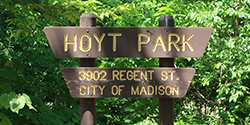
| Address: | 3902 Regent St. |
| Hours: | 4:00am - 10:00pm |
| Park Type: | Community |
| Acres: | 22.63 |
| Restroom: | No |
| Drinking Water: | Yes |
Park Details
Quiet and slightly removed from the congested thoroughfare of Madison traffic, Hoyt Park is an ideal location for either a substantial, social gathering or a peaceful stroll through forest and prairie habitat. The naturalist will enjoy the lush mix of young, and old-growth vegetation that is laced by a network of paved and unpaved hiking trails. The sports enthusiast will find a full-sized basketball court, a softball field, and a grassy, clearing suitable for soccer, football, or Frisbee. In addition, the two highly, hospitable shelters will appease the socialites and the play equipment will occupy the children. At the same time, the past comes alive thanks in large part to not only the many restored historic fireplaces (twelve precisely) scattered like ancient treasures throughout, but also the restored prairie, rock and tree formations that envelop the park.Alternate address: 3201 Bluff Street.
Park Highlights

At this Park
-
 Basketball Court
Check out the hoops in your neighborhood! According to the Trust for Public Land's ParkScore (2025), Madison scores 100 out of 100 points or 9.3 per 10,000 people, for the number of basketball hoops provided to its residents.
View all Basketball Courts
Most of the basketball courts are available on a first-come, first-served basis. If you are planning a new league or tournament
Reserve Online-
Hoyt Park - Basketball Court
Surface: Asphalt
Lighted: No
Number of Courts: 1 full
-
-
 Fireplace
Madison Parks has several parks with working fireplaces. You are welcome to use the fireplaces with your park shelter reservation. Hoyt Park also has several refurbished outdoor fireplaces where you can enjoy toasted marshmallows and a quiet evening around a fire. Just remember to bring your own wood and extinguish the fire completely before leaving the park. Please note, fires are not permitted in Vilas Park during the winter months.
Fireplace
Madison Parks has several parks with working fireplaces. You are welcome to use the fireplaces with your park shelter reservation. Hoyt Park also has several refurbished outdoor fireplaces where you can enjoy toasted marshmallows and a quiet evening around a fire. Just remember to bring your own wood and extinguish the fire completely before leaving the park. Please note, fires are not permitted in Vilas Park during the winter months.
With the guidance of the Madison Fire Department and MGO 34.07, fires in general parks (not in a conservation park) are allowed with the following rules:- Fire has a spark arrestor or heavy screen to contain the embers and sparks
- Fire has at least 10 ft. clearance from combustibles
- Smoke does not create a nuisance
- Fire is continuously monitored and maintained by an adult
- A method to extinguish the fire is readily available
-
 Hiking
Explore the many scenic trails and pathways throughout Madison Parks. Year-round restrooms are available at Cherokee Marsh, North and Owen conservation parks.
Hiking
Explore the many scenic trails and pathways throughout Madison Parks. Year-round restrooms are available at Cherokee Marsh, North and Owen conservation parks.
MAPS
Looking for a trail map for a particular park? A number of the individual park pages provide a trail map. Check out the "About This Park" section of your favorite park. Don't see a map? Let us know!
Dogs
Most parks allow leashed & licensed dogs with a Dog Permit. However, dogs are prohibited in all conservation parks and a few other locations. See Dog Free Parks for more information. View all Hiking -
 Multipurpose Field
Open or Multipurpose Fields are reservable athletic fields with no game-specific design or limitations. Often used for soccer, ultimate, lacrosse or football, yet open to your imagination. Multipurpose Fields are located throughout the city and may be used on a first-come, first-served basis if not already reserved. RESERVE ONLINE
View all Multipurpose Fields
SPECIALIZED FIELDS
Specialized fields include soccer, cricket, ball diamonds - baseball or softball and both fenced and non-fenced, may be viewed on the individual pages. See the sidebar on the Athletics webpage.-
Hoyt Park - Multipurpose Field
-
-
 Parking Lot
Parking lots in parks are available for park programs or events during regular park hours: 4:00 am to 10:00 pm.
Parking Rules
- Driving or parking motorized vehicles is not allowed on the grass or near a shelter and is subject to a citation.
- Three-hour limit in all parks, as posted.
- No parking after hours: 10pm to 4am. Overnight parking is not allowed.
- Conservation park hours are 4am until one hour after sunset
- Follow all onsite parking regulation signs.
- Violators are subject to a fine.
Bus Parking
The City of Madison offers free, bus parking in the rear lot of Duane F. Bowman Park, 1775 Fish Hatchery Road, 53713. See Bus Parking Map for more information. This is the only designated City of Madison parking lot. All other locations, such as Olin Park, Turville Point Conservation Park, and Vilas Park Drive are prohibited and subject to a citation.
Law Park: metered parking stalls
The parking lot located on the eastern side of Law Park, commonly known as the Blair Lot, is a metered parking lot, enforced by City of Madison Parking Division between the hours of 6:00 a.m. and 6:00 p.m. Monday through Friday.
View all Parking Lots -
 Playground
With more than 175 playgrounds throughout Madison, you are never too far from a playground. According to the Trust for Public Land's ParkScore (2025), Madison scores 100 out of 100 points or 32.6 per 10,000 children, for the number of basketball hoops provided to its residents.
Playground for Everyone
Through the Madison Parks Foundation initiative, Madison Parks offers accessible playgrounds in Brittingham, Elver, Rennebohm and Warner parks. An accessible playground is anticipated in Reindahl Park in the near future.
Nature Playgrounds
A nature playground uses natural materials such as logs, rocks, plants, and the surrounding land to create a play environment that encourages children to explore and connect with nature. Nature play elements can combined with traditional playground equipment like slides, swings and climbers. Check out Brittingham Park and Olbrich Park to get you started, other parks include Paunack, Garner, Tenney, Westmorland and Wingra.
Playground Replacements: How and When
Madison Parks is responsible for maintaining more than 175 playgrounds and began a system-wide replacement initiative in 2013. With current staff and funding resources, replacements are scheduled to continue through 2033. Playgrounds are routinely inspected to assess the equipment's condition and repair any safety concerns. Based on the age of the equipment and current conditions, each is given an audit score. The number of playgrounds replaced each year is based on budget allocations, staffing resources, and the current playground audit score for prioritization.
Replacement Process: Neighborhood Input
At the start of the replacement process, notices are sent to the District Alder, neighborhood association representatives, and surrounding residential addresses. Information is also posted to the project website. Generally, two public meetings are held to review surfacing and equipment options and make final selections.
View all Playgrounds
If you have questions about a specific playground or see something broken, please let us know.-
Hoyt Park - Playground
-
-
 Scenic Overlook
Many of the Madison Parks are located in ideal locations for sight seeing. Enjoy the view! View all Scenic Overlooks
Scenic Overlook
Many of the Madison Parks are located in ideal locations for sight seeing. Enjoy the view! View all Scenic Overlooks -
 Slacklining and Hammocking
Slacklining or hammocking in a park is allowed following the guidelines below at specific times, on specific trees, and never in a conservation park. Always keep in mind, Park Rangers have the authority to remove or order the removal of any slackline or hammock which they deem as harmful to the tree or as a danger to the safety of park users. The best advice, WHEN IN DOUBT, DON'T.
Slacklining and Hammocking
Slacklining or hammocking in a park is allowed following the guidelines below at specific times, on specific trees, and never in a conservation park. Always keep in mind, Park Rangers have the authority to remove or order the removal of any slackline or hammock which they deem as harmful to the tree or as a danger to the safety of park users. The best advice, WHEN IN DOUBT, DON'T.
Dos and Don'ts
Tethering to trees for the purpose of slacklining or hammocking is allowed following these guidelines:- DO: Sunrise to 30 minutes prior to sunset
- DO: Temporary only and may never be left unattended or overnight
- DO: Only on trees greater than 1' in diameter and 4.5'
- DO: Tree protect is used at connection points
- DON'T: Never tether on Oak, Hickory or Birch trees
- DON'T: Never in any conservation park
Proper Tree Protection
Tree protection is required for tethering any equipment to help prevent damage to the tree's bark. Carpet, foam pads or towels make good protection. Make sure the fabric padding completely encircle the tree at the connection points and is a minimum of ¼" thick by 10" wide. For more information and examples, see Tree Protection.
Prohibited Trees
Never tether on an oak, hickory or birch tree. When in doubt, don't. For more information, see Tree Identification.
When in Doubt, Don'tPark Rangers have the authority to remove or order the removal of any slackline or hammock which they deem as harmful to the tree or as a danger to the safety of park users.
View all Slacklining and Hammocking -
 Snowshoeing
Snowshoeing in Madison Parks
Experience winter in Madison Parks like never before with snowshoeing! This silent sport is a fantastic way to explore many of our parks during the winter months and is easy to learn. In general parks, snowshoeing is allowed anywhere with good snow cover; typically, this means at least 6" or more. Snowshoeing is not allowed off-trail in a conservation park or on a designated cross-country ski trail.2025-26 Designated Snowshoe Trail Maps
Snowshoe Rentals & Concessions
Concessions and snowshoe rentals are offered as conditions allow at the staffed warming pavilion at Door Creek, Elver and Vilas parks. See Cross-Country Ski for hours and status.Hourly Rentals
Available from Door Creek, Elver and Vilas.Type Price Adult $5/ hour Youth - age 15 & younger $3/ hour Each additional hour (adult or youth) $2/ hour Daily Rentals
Longer-term snowshoe rentals are available from Elver and VilasType Price Adult $25/ day; $15 each additional day Youth - age 15 & younger $10/ day; $5 each additional day Where to Snowshoe Guidelines & Tips
- Anywhere with good snow cover, on or off-trail, in a general park that is not a designated cross-country ski trail.
- On trail only, in a conservation park, that is not a designated cross-country ski trail.
- Snowshoeing, hiking, and skiing off-trail can destroy snow tunnels used by native small rodents (deer mice, shrews) due to trampling. These small mammals are an important part of the wetland and grassland ecology in our conservation parks. Destruction of these tunnel networks makes small mammals more vulnerable to predation.
- When in doubt, it's always best to stay on a trail.
- Our trail systems are designed to facilitate controlled public access while protecting environmentally sensitive areas and providing a quiet refuge for wildlife away from people. Disruption of wildlife by human activity during winter adds to the stress they face during a challenging time for their survival.